General information, not medical advice. Every baby is different — if anything worries you, speak to your midwife, health visitor or GP rather than waiting.
Your baby is here, but your body is still finishing a very different job: healing from the inside out. If you’re breastfeeding and wondering how long does bleeding last after birth if breastfeeding, you’re asking one of the most common postpartum questions there is.
Table of Contents
How Long Does Bleeding Last After Birth If Breastfeeding?
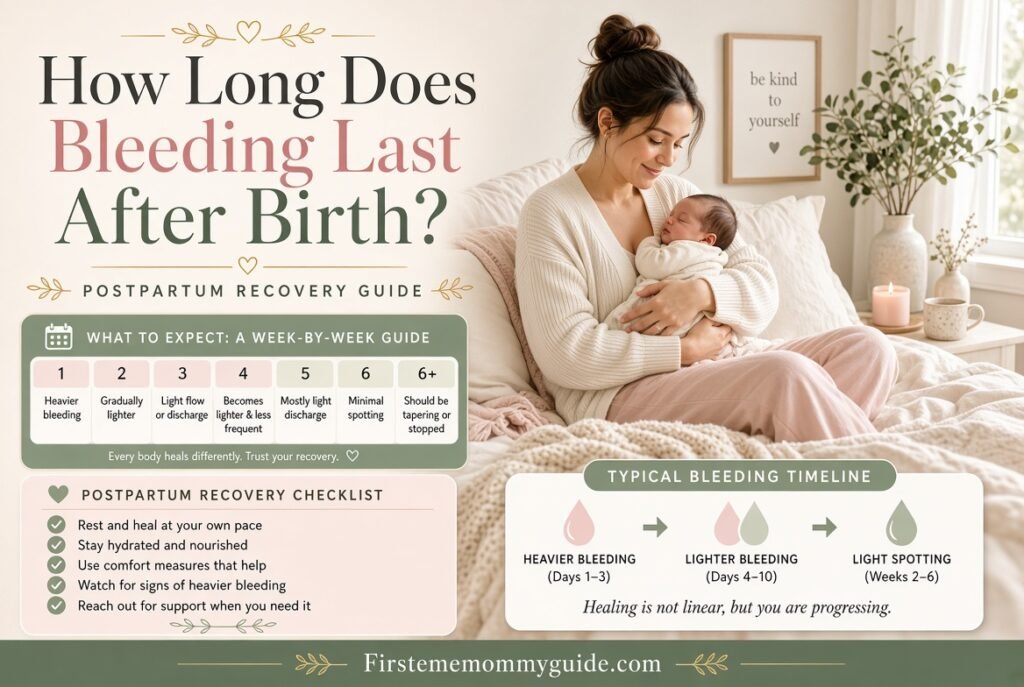
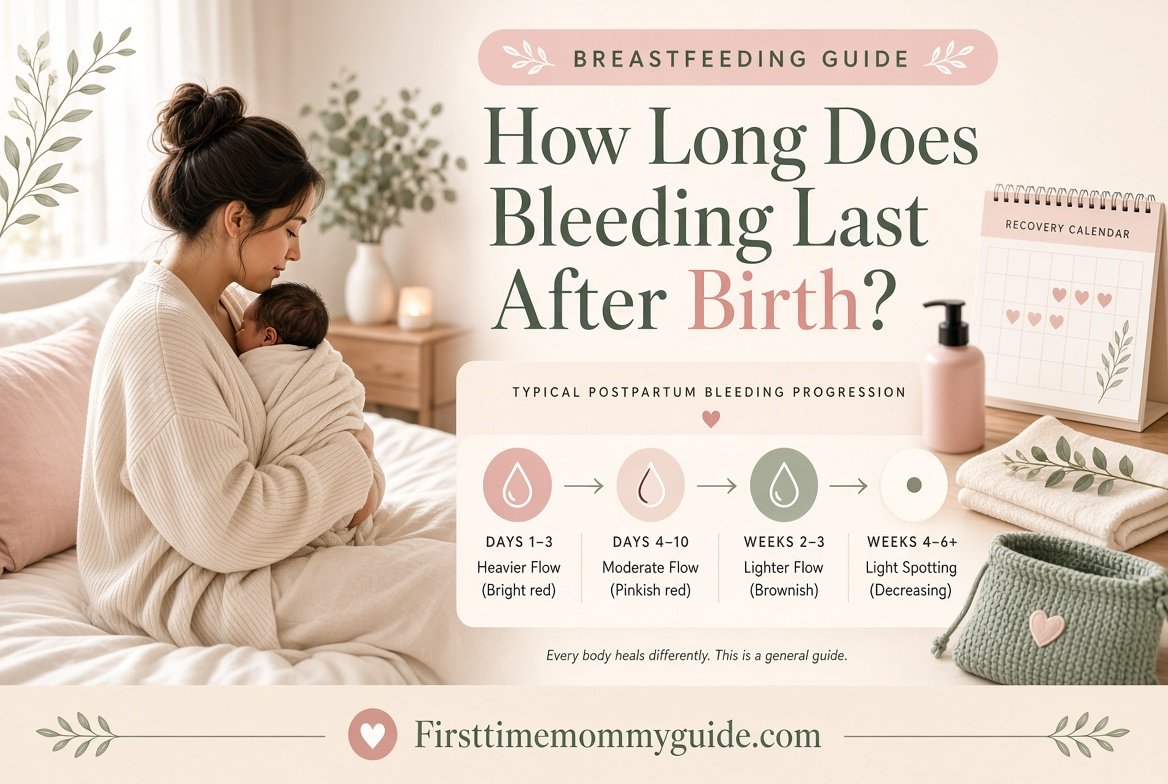
Postpartum bleeding, called lochia, typically lasts four to six weeks whether or not you’re breastfeeding. Some women notice light spotting for up to eight weeks.
Breastfeeding doesn’t shorten or lengthen this window in a major way. It does cause short bursts of heavier bleeding during and right after nursing sessions.
What Is Lochia?
Lochia is the vaginal discharge of blood, mucus, and uterine lining tissue that follows every birth, vaginal or C-section. It’s your uterus shedding what it no longer needs as it shrinks back toward its pre-pregnancy size.
This process happens no matter how you fed your baby. Breastfeeding simply changes the pattern slightly, not the overall timeline.
The Three Stages of Postpartum Bleeding
Lochia moves through predictable color and flow changes as healing progresses.
| Stage | Timing | What It Looks Like |
|---|---|---|
| Lochia rubra | Days 1–4 | Bright red, heavy, may include small clots |
| Lochia serosa | Days 4–12 | Pinkish-brown, thinner, lighter flow |
| Lochia alba | Day 12 to week 4–6 | Yellowish-white, spotty, minimal |
Bleeding is heaviest in the first few days and tapers gradually. It’s normal for it to fade, then briefly turn red again if you’re more active than usual.
Why Breastfeeding Affects Bleeding
Nursing releases oxytocin, the same hormone responsible for your milk letdown. Oxytocin also makes the uterus contract.
Those contractions, often called afterpains, squeeze the uterus back into shape faster. They can also push out a small gush of blood right when your baby latches on.
Many moms notice this pattern in the first one to two weeks. It becomes less intense as the uterus continues to shrink and heal.
Breastfeeding, Bleeding, and Your Period: What’s Different
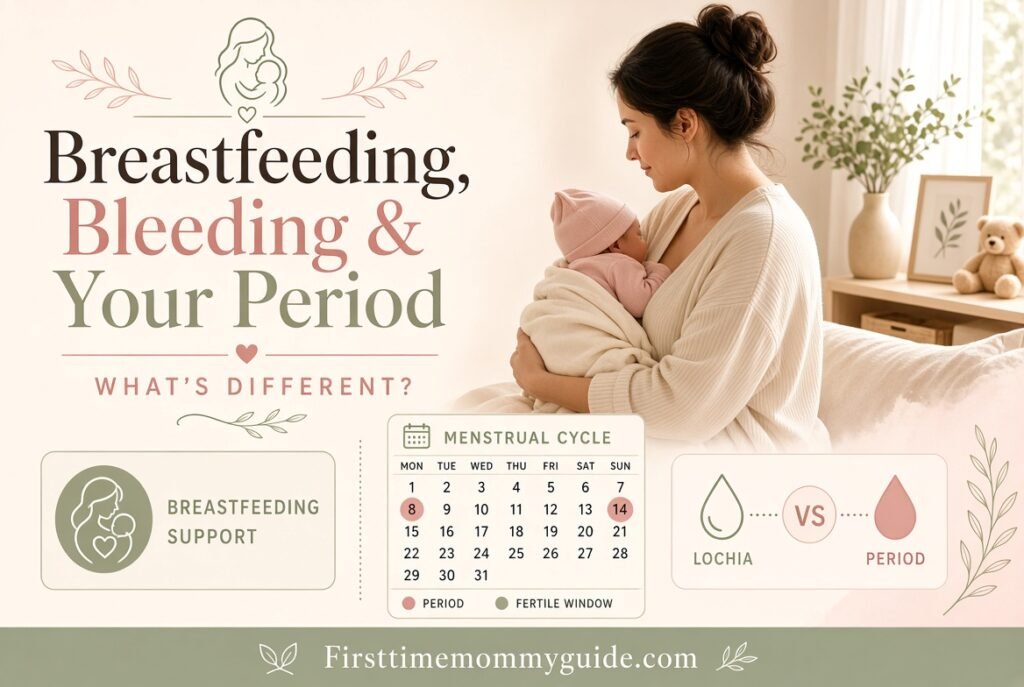
Breastfeeding has a bigger effect on when your period returns than on lochia itself.
- Exclusively breastfeeding moms often don’t see a period return for several months, sometimes not until baby is partly weaned.
- Non-breastfeeding moms typically see their period return within six to eight weeks.
- Ovulation can happen before your first period shows up, so breastfeeding alone isn’t reliable birth control.
- How often and how exclusively you nurse affects how long your period stays away.
Vaginal Birth vs. C-Section: Does It Change the Timeline?
Both delivery methods involve lochia because the placenta separates from the uterine wall either way.
| Factor | Vaginal Birth | C-Section |
|---|---|---|
| Lochia occurs | Yes | Yes |
| Typical heaviness | Slightly heavier | Often slightly lighter |
| Afterpains from nursing | Yes | Yes |
| Overall duration | 4–6 weeks | 4–6 weeks |
A C-section doesn’t skip lochia, even though the uterus wasn’t directly disturbed by delivery. Some women notice it’s a bit lighter simply because less trauma occurred at the cervix and vaginal opening.
Normal vs. Concerning Postpartum Bleeding
Most bleeding, even the surprising gushes during breastfeeding, is completely normal. A short checklist helps you tell the difference.
- Normal: gradual lightening in color, small clots smaller than a grape, brief spikes while nursing.
- Call your provider: soaking a pad in under an hour for two hours straight, clots larger than a golf ball, or bleeding that suddenly gets heavier after slowing down.
- Seek care right away: fever, chills, foul-smelling discharge, dizziness, or a racing heartbeat alongside bleeding.
These symptoms can point to postpartum hemorrhage or infection, both of which need prompt medical attention.
Tips for Managing Postpartum Bleeding While Nursing
A few simple habits make the first few weeks more comfortable.
- Use thick maxi pads, never tampons, until your provider clears you at your postpartum visit.
- Keep a pad nearby before nursing sessions, since a small gush is common right at letdown.
- Take an NSAID like ibuprofen, if approved by your provider, to ease afterpain cramping.
- Rest when you can, since overexertion often brings bleeding back after it had slowed.
- Track pad counts and clot size for the first two weeks so you notice changes quickly.
Mistakes to Avoid During Recovery
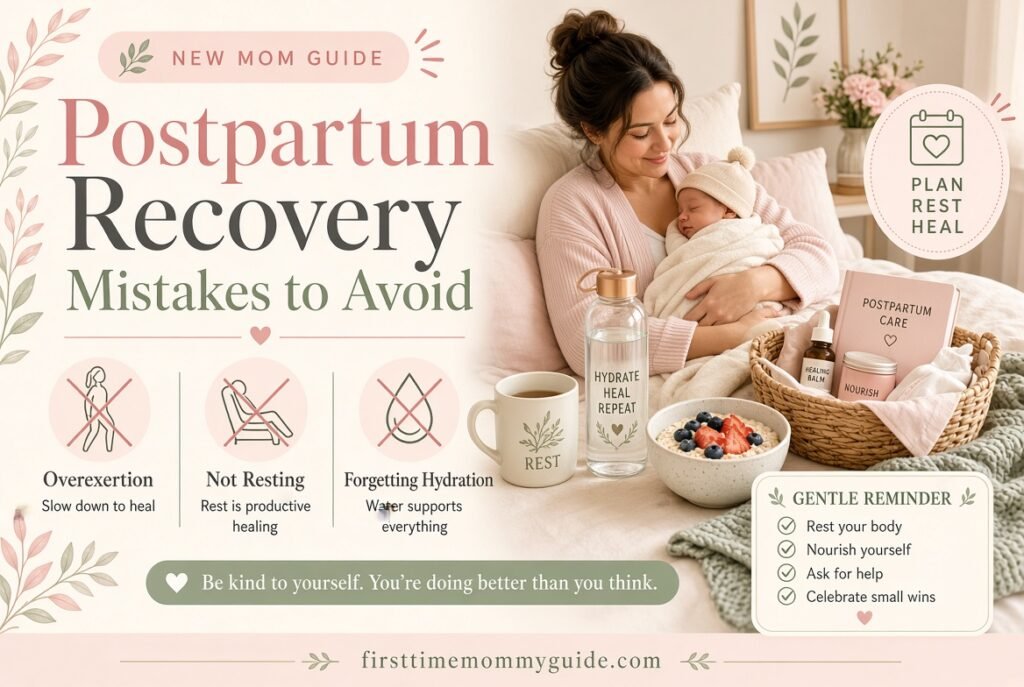
A few habits tend to prolong bleeding or increase infection risk.
- Using tampons or menstrual cups before your six-week check.
- Resuming intense exercise or heavy lifting too early.
- Having penetrative sex before your provider gives the go-ahead.
- Ignoring a sudden increase in bleeding because “it’s probably just from breastfeeding.”
Also Read:
- How Long Do You Bleed After You Give Birth? Full Timeline Guide 2026
- Bleeding After Birth Stopped Then Started Again: Causes and Warning Signs 2026
- After Giving Birth First Period: Timeline, Symptoms & What’s Normal 2026
- Pregnancy Guide, Month by Month
- Pelvic Pain During Pregnancy: Causes, Relief & When to Worry 2026
- SPD Pregnancy: Symptoms, Causes & Relief Tips (2026 Guide)
- Sex Positions to Induce Labor: Safe Options (2026)
- Sunny Side Up Baby: What It Means, Why It Happens & How to Turn Baby (2026 Guide)
- Best Electrolytes for Pregnancy: Safe Picks & Expert Tips (2026)
- How to Become a Midwife: Complete Step-by-Step Guide 2026
- Baby Sleep Guide for New Moms: Safe Sleep & Schedules (2026)
- Baby Sleep Guide, Honestly
- Baby Essentials Checklist, 0–3 Months
- Hospital Bag Checklist for Baby: The Complete Packing List 2026
- Newborn Coming Home Outfit: What to Pick, What to Skip, and How to Keep Baby Safe
- Baby Won’t Eat? Common Reasons, Fixes & When to Worry 2026
- When Can My Baby Start Eating Real Food? Age, Signs & First Foods 2026
- Baby Food Guide, 6–12 Months
- Baby Food Chart 6 to 12 Months: Free Month-by-Month Feeding 2026
- Fruit Purees for 6 Month Old Babies: Safe Recipes & Guide (2026)
- Best Vegetable Purees for Baby: A Complete Age-by-Age Guide 2026
- Baby Food Combo Purees: The Complete Age-by-Age Guide 2026
- Best Baby Food Combinations: A Complete Age-by-Age Guide for Parents 2026
- When Do Infants Roll From Tummy to Back? (2026 Guide)
- When Do Babies Start Sitting Up? Month-by-Month Milestone Guide 2026
Frequently Asked Questions (FAQs)
How long does bleeding last after birth if breastfeeding?
Most breastfeeding moms bleed for four to six weeks, with some light spotting continuing up to eight weeks. Breastfeeding causes short spikes in flow but doesn’t change the overall length much.
Does breastfeeding make postpartum bleeding heavier?
It can cause brief, noticeable gushes during nursing because oxytocin triggers uterine contractions. The total amount of blood lost over the recovery period isn’t significantly higher than in non-breastfeeding moms.
Why does bleeding increase every time I nurse?
Nursing releases oxytocin, which makes your uterus contract to help it shrink back to size. Those contractions can squeeze out extra lochia, especially in the first couple of weeks.
When should postpartum bleeding turn brown or pink?
Bleeding typically shifts from bright red to pink or brown somewhere between day four and day twelve. This marks the move from lochia rubra into lochia serosa.
Is it normal for bleeding to stop and then start again?
Yes, especially if you’ve been more physically active than your body was ready for. It usually settles back down with rest, but tell your provider if it becomes heavy or doesn’t ease off.
How much bleeding is too much after birth?
Soaking through a pad in under an hour, passing clots larger than a golf ball, or bleeding that suddenly worsens are all reasons to contact your provider. These can signal postpartum hemorrhage.
Can I use tampons for postpartum bleeding?
No. Tampons and menstrual cups raise infection risk while your cervix and uterus are still healing. Stick to thick pads until your six-week checkup clears you.
Does a C-section reduce how long you bleed?
Not by much. Lochia still occurs after a C-section since the placenta separates from the uterus regardless of delivery method, though it’s sometimes a bit lighter.
When will my period return if I’m breastfeeding?
Exclusive breastfeeding can delay your period for several months, sometimes until you start weaning. This varies widely based on how often and how exclusively you nurse.
Can I get pregnant while breastfeeding and still bleeding?
Yes. Ovulation can happen before your period returns, so breastfeeding is not a dependable form of contraception.
Is cramping during breastfeeding normal?
Yes, these are called afterpains and are caused by the same oxytocin release that triggers your milk letdown. They’re usually strongest in the first few days and fade within one to two weeks.
What helps with afterpain cramping?
An NSAID like ibuprofen, taken as your provider recommends, is commonly used to ease the discomfort. Emptying your bladder before nursing and using a warm compress can also help.
How soon can I have sex after birth?
Most providers recommend waiting until after your six-week postpartum checkup. This gives your cervix, uterus, and any tearing time to heal fully.
What color should lochia be by six weeks?
By six weeks, discharge should be minimal and closer to yellowish-white or have stopped entirely. Bright red bleeding at this point is worth mentioning to your provider.
Should I track my bleeding after birth?
Yes, especially in the first two weeks. Noting pad saturation, clot size, and color changes helps you and your provider spot anything unusual early.
Conclusion
For most breastfeeding moms, postpartum bleeding follows a predictable four-to-six-week arc, with a few surprise gushes during nursing sessions along the way. That pattern is your body doing exactly what it’s supposed to do as it heals.
Keep an eye on pad counts, clot size, and any fever or foul smell, and don’t hesitate to call your provider if something feels off. When in doubt, a quick check-in is always better than waiting it out.

Dilawar Mughal
Founder and editor, First Time Mommy Guide
I research every guide against what the NHS, the AAP and the WHO publish, then write it in plain English — because most new parents are reading with one hand free, not comparing clinical guidelines. I'm not a doctor or a midwife. Every health claim on this site is sourced and linked so you can check it yourself, and anything urgent belongs with your health visitor or GP, not a blog.