
General information, not medical advice. Every baby is different — if anything worries you, speak to your midwife, health visitor or GP rather than waiting.
If your doctor just told you that you have a sunny side up baby, you’re probably picturing breakfast, not birth. It’s a real term, and it’s more common than most first-time moms expect.
Table of Contents
What Does “Sunny Side Up Baby” Mean?
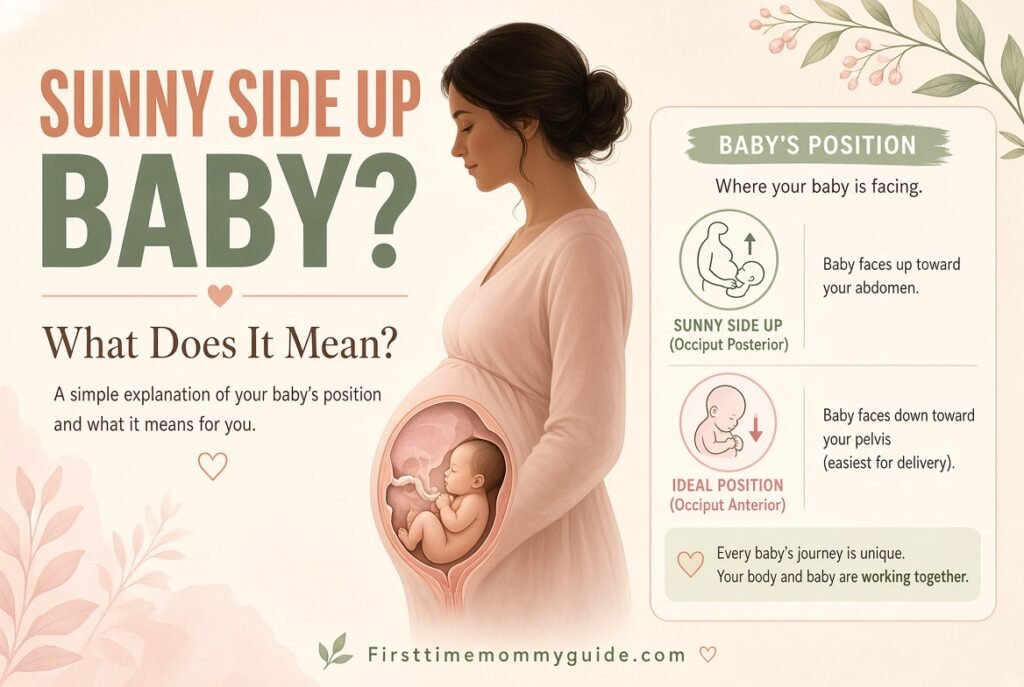
A sunny side up baby is head-down and ready for birth, but facing your belly instead of your spine. The medical term is occiput posterior (OP) position.
This is different from breech, where baby’s head isn’t down at all. A sunny side up baby is still positioned correctly for a vaginal birth; only the direction baby is facing is off.
Most babies naturally rotate to face your spine (occiput anterior) sometime before or during labor. When that rotation doesn’t happen, baby stays sunny side up.
Occiput Anterior vs Occiput Posterior: Why Direction Matters
The back of your baby’s skull is called the occiput. Where that occiput points determines whether labor is smoother or more difficult.
| Position | Baby’s Direction | Labor Impact |
|---|---|---|
| Occiput Anterior (OA) | Facing your spine | Easiest position; chin tucks naturally |
| Occiput Posterior (OP) / Sunny Side Up | Facing your belly | Often longer, more painful labor |
| Occiput Transverse (OT) | Facing your side | May rotate to OA or OP during labor |
In the OA position, baby’s chin tucks into the chest, which makes the smallest part of the head lead the way through the pelvis. In the OP position, the head is less tucked, so a wider angle has to pass through.
What Causes a Baby to Be Sunny Side Up?
There’s no single cause, but a few factors are linked to a higher chance of an OP baby.
- First pregnancies, since the uterus and pelvic muscles haven’t stretched from a prior birth
- A narrower or android-shaped pelvis
- Excess time spent reclining or sitting slouched back on a couch
- Low muscle tone or a very relaxed uterine wall late in pregnancy
- Anterior placenta in some cases, which can affect how baby settles
None of these mean you did something wrong. Baby’s position often has more to do with anatomy and daily posture than anything you can fully control.
Signs Your Baby Might Be Sunny Side Up
You can’t always tell from the outside, but there are a few common clues.
- Kicks and movement felt mostly at the front of your belly
- A belly that looks flatter or slightly dipped in the middle instead of rounded
- Intense lower back pain during contractions, often called “back labor”
- Irregular or stalled contractions during early labor
A definitive answer usually comes from your provider, not from guessing at home.
How Is a Sunny Side Up Position Confirmed?
Your midwife or doctor typically confirms this in one of two ways.
A manual exam during labor lets them feel the soft spots (fontanelles) on baby’s skull to determine which way the head is facing. A bedside ultrasound can also confirm the position quickly and painlessly.
Position can still change right up until delivery, so a posterior finding at 36 or 37 weeks isn’t the final word.
Risks and Complications of a Sunny Side Up Baby
Most sunny side up babies are born safely and healthily. Still, it’s worth understanding the possible complications.
- Longer first and second stages of labor
- More intense back pain during contractions
- Higher chance of needing an assisted delivery with forceps or a vacuum
- Slightly higher likelihood of a C-section if labor stalls
- Increased risk of perineal tearing during a vaginal delivery
Knowing these risks isn’t meant to scare you. It’s meant to help you prepare and ask informed questions at your appointments.
Can a Sunny Side Up Baby Be Born Vaginally?

Yes. Many OP babies are delivered vaginally with no lasting issues for mom or baby.
Roughly 1.8% to 8.4% of babies are in the occiput posterior position during labor, and a large share of them still rotate on their own before pushing begins. Even babies who stay posterior through delivery are frequently born without complications.
How to Turn a Sunny Side Up Baby: Exercises That May Help
While nothing guarantees a rotation, several low-risk techniques are widely recommended by midwives, doulas, and physical therapists to encourage baby to turn.
Forward-Leaning Inversion
Kneel at the edge of a couch or bed and slowly lower your hands to the floor so your hips are higher than your head. Hold for a few slow breaths, then rise carefully. Avoid this if you have high blood pressure, dizziness, or reflux.
Hands-and-Knees Pelvic Tilts
Get into a tabletop position and alternate gently arching and rounding your back, similar to a cat-cow stretch. This uses gravity to encourage baby’s heavier head to rotate forward.
Side-Lying Release
Lie on a firm surface on your left side with your bottom leg bent and top leg relaxed off the edge. Hold for three to five minutes, then switch sides. This is designed to release tight pelvic ligaments so baby has more room to move.
Hip Dips and Pelvic Circles
Lean over a counter or sit on a birth ball and do gentle figure-eight or hip-lifting movements. This helps loosen the pelvis and create space for rotation.
Everyday Posture Changes
- Avoid reclining on your back or slouching on soft couches
- Sit leaning slightly forward with hips higher than your knees
- Try swimming or resting on your stomach if it’s comfortable
- Take regular walks, especially on uneven ground
None of these techniques are guaranteed. They’re considered low-risk, so many moms try them anyway while talking with their provider first.
What Happens If Baby Stays Sunny Side Up During Labor
If baby doesn’t rotate before pushing, your provider will monitor labor progress closely. Position changes like hands-and-knees pushing, side-lying, or using a peanut ball can still encourage rotation during active labor.
If labor stalls significantly or baby shows signs of distress, your team may recommend an assisted vaginal delivery or a C-section. This decision is based on your specific labor, not a fixed rule.
Sunny Side Up Baby: Pros and Cons
| Aspect | What to Expect |
|---|---|
| Vaginal delivery | Still possible; many OP babies rotate on their own |
| Labor length | Often longer than average |
| Pain pattern | More intense back pain, less typical abdominal pressure |
| Intervention risk | Slightly higher chance of assisted delivery or C-section |
| Baby’s outcome | Generally healthy, same as anterior-positioned babies |
Best Practices to Support Baby’s Position
- Start posture awareness in the third trimester, not just at 40 weeks
- Ask your provider to check position at routine appointments
- Practice forward-leaning positions daily rather than only during labor
- Stay upright and mobile during early labor if your provider approves
- Keep a calm mindset; stress doesn’t cause posterior positioning
Mistakes to Avoid
- Assuming a posterior finding at 34–36 weeks is permanent
- Spending long hours reclined on a couch or car seat
- Skipping movement because you feel too tired or uncomfortable
- Trying advanced inversions without checking for medical contraindications
- Panicking instead of discussing options calmly with your care team
When to Call Your Doctor or Midwife

Reach out promptly if you notice a sudden drop in baby’s movement, severe or unusual pain, vaginal bleeding, fluid leaking, or contractions that feel very different from what you were told to expect. A sunny side up finding alone is not an emergency, but any of these additional signs deserve a call.
Also Read:
- Pregnancy Guide, Month by Month
- Baby Essentials Checklist, 0–3 Months
- Hospital Bag Checklist for Baby
- Sex Positions to Induce Labor: Safe Options
- Pelvic Pain During Pregnancy: Causes, Relief & When to Worry
- SPD Pregnancy: Symptoms, Causes & Relief Tips
- 33 Weeks Pregnant: Symptoms, Baby Development & What to Expect
- How Long Do You Bleed After You Give Birth? Full Timeline Guide
- Maternity Leggings: The Complete Guide for Every Trimester
- Leggings in Pregnancy: Is It Safe to Wear Them Every Trimester?
- Newborn Coming Home Outfit: What to Pick and Skip
- Baby Sleep Guide for New Moms: Safe Sleep & Schedules
- When Do Babies Start Sitting Up? Month-by-Month Guide
- When Do Babies Start Rolling Over?
- When Do Babies Start Smiling? Signs & Milestones
- Baby Food Chart 6 to 12 Months: Free Month-by-Month Feeding
- When Can My Baby Start Eating Real Food?
- Best Baby Food Combinations: A Complete Age-by-Age Guide
- Baby Food Combo Purees: The Complete Age-by-Age Guide
- Best Vegetable Purees for Baby: A Complete Age-by-Age Guide
- Fruit Purees for 6 Month Old Babies: Safe Recipes & Guide
- Baby Won’t Eat? Common Reasons, Fixes & When to Worry
Frequently Asked Questions (FAQs)
What does sunny side up mean for a baby?
It means baby is head-down but facing your belly instead of your spine, known medically as the occiput posterior position.
Is a sunny side up baby dangerous?
Not usually. It can lead to a longer, more painful labor, but most sunny side up babies are born healthy.
Can a sunny side up baby turn on its own?
Yes. Many babies rotate on their own before or during labor without any intervention.
How common is a sunny side up baby?
It occurs in roughly 1.8% to 8.4% of labors, making it the most common fetal malposition.
What causes back labor?
Back labor happens when baby’s skull presses against your spine, which is common with a sunny side up position.
Can I still have a natural birth with a posterior baby?
Yes, many women deliver vaginally without medication even when baby is posterior, though labor may take longer.
When is baby’s position usually checked?
Position is often checked in routine third-trimester appointments and again once labor begins.
Does a posterior baby mean I’ll need a C-section?
No. It slightly raises the odds of interventions, but most sunny side up babies are still born vaginally.
What exercises help turn a posterior baby?
Forward-leaning inversions, hands-and-knees pelvic tilts, side-lying release, and hip dips are commonly recommended.
Is it safe to do inversions during pregnancy?
Generally yes for low-risk pregnancies, but avoid them if you have high blood pressure, dizziness, or reflux, and check with your provider first.
Can sleeping position affect baby’s position?
Yes, extended time reclining or sitting slouched may encourage baby to settle in a posterior position.
Does an anterior placenta increase the chance of a posterior baby?
It can be a contributing factor in some pregnancies, though it isn’t the only cause.
How do I know if my baby has turned?
Reduced back pain, more regular contractions, and a confirmed check by your midwife are the clearest signs.
Is back labor always a sign of a sunny side up baby?
Not always, but it’s one of the more common causes of intense lower back pain during contractions.
Can a chiropractor help turn a posterior baby?
Some women use prenatal chiropractic care alongside movement techniques, though results vary and it isn’t guaranteed.
Does a sunny side up position affect the baby after birth?
No, once born, a baby’s position during labor has no lasting effect on their health or development.
Are first-time moms more likely to have a posterior baby?
Yes, first pregnancies are statistically linked to a slightly higher chance of an OP position.
What is the peanut ball used for during labor?
It’s placed between the knees while lying on your side to help open the pelvis and encourage rotation.
Can walking help turn a sunny side up baby?
Walking, especially on uneven surfaces, can encourage movement and may help baby shift position.
Is a posterior baby more likely with a narrow pelvis?
A narrower or android-shaped pelvis is associated with a higher likelihood of a posterior position.
How long can labor take with a sunny side up baby?
It varies widely, but posterior labors are often longer than average, sometimes by several hours.
Should I be worried if my baby is posterior at 36 weeks?
Not necessarily. Baby can still rotate multiple times before delivery, so it’s too early to be concerned.
Can swimming help reposition a baby?
Some providers suggest swimming, particularly floating on your stomach, as a gentle way to encourage rotation.
What is the difference between posterior and transverse position?
Posterior means baby faces your belly, while transverse means baby faces one of your sides; both can shift during labor.
Do doctors always mention if my baby is sunny side up?
Most providers will mention it if found during a late-pregnancy exam or during labor, since it can affect your birth plan.
Conclusion
A sunny side up baby simply means the back of baby’s head is facing your belly instead of your spine during labor. It’s common, it’s manageable, and most babies are born safely whether they rotate or not.
Talk with your midwife or doctor about your specific pelvis, labor plan, and which positioning techniques make sense for you. With the right support, a sunny side up baby is rarely something to fear.

Dilawar Mughal
Founder and editor, First Time Mommy Guide
I research every guide against what the NHS, the AAP and the WHO publish, then write it in plain English — because most new parents are reading with one hand free, not comparing clinical guidelines. I'm not a doctor or a midwife. Every health claim on this site is sourced and linked so you can check it yourself, and anything urgent belongs with your health visitor or GP, not a blog.