General information, not medical advice. Every baby is different — if anything worries you, speak to your midwife, health visitor or GP rather than waiting.
Three weeks after birth, the bleeding had faded to almost nothing. Then one morning it came back, and this time it was bright red.
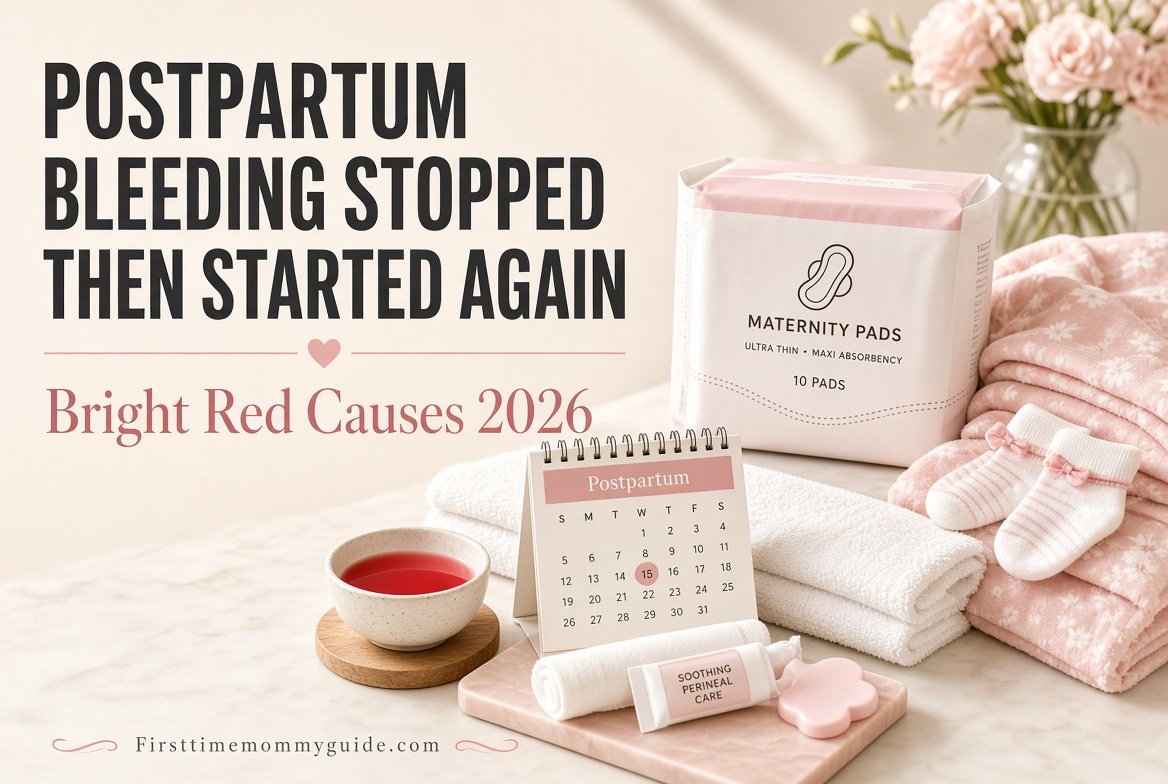
Postpartum bleeding stopped then started again bright red is one of the most common recovery worries new moms search for, and it usually has a simple explanation. The bleeding you experience after birth is called lochia — discharge made of blood, mucus, and uterine tissue shed from where the placenta was attached.
Lochia normally fades in stages, from red to pink to a creamy yellow-white, over about four to six weeks. So when fresh red blood reappears after things seemed to be settling, it can feel like your body is moving backwards instead of healing.
Table of Contents
Postpartum Bleeding Stopped Then Started Again Bright Red

A short return of bright red bleeding in the first 6 weeks is often normal. It usually means the placental site scab has come away or that you have been more active than your body was ready for.
But bleeding that gets heavier, comes with fever or foul odor, or returns after stopping completely for several days deserves a call to your provider. It can signal retained placental tissue, infection, or secondary postpartum hemorrhage.
Get Emergency Help Immediately If You Have Any of These
- Soaking through a full-size pad in one hour or less
- Passing clots larger than a golf ball, especially repeatedly
- Feeling dizzy, faint, weak, clammy, or short of breath
- A racing heartbeat or blurred vision
- Severe pain in your lower belly that is getting worse
- Fever of 100.4°F (38°C) or higher with bleeding
Do not wait for a callback and do not drive yourself if you feel lightheaded. Signs of significant blood loss often do not appear until a large volume has already been lost, which is why prompt care matters so much.
First, Understand What Lochia Actually Is
Lochia is the vaginal discharge your body produces as the uterus heals after birth. It is not a period, and it lasts far longer than one.
It contains blood, mucus, and uterine tissue from where the placenta was attached. Every person who gives birth has it, including after a C-section.
The Three Stages of Lochia
| Stage | Timing | Color | What It Looks Like |
|---|---|---|---|
| Lochia rubra | Days 1–4 | Bright to dark red | Heaviest flow, small clots |
| Lochia serosa | Days 4–10 | Pink or brownish | Thinner, lighter flow |
| Lochia alba | Day 10 onward | Yellowish white or cream | Light discharge, minimal blood |
Lochia normally fades gradually rather than stopping suddenly and restarting. That distinction matters, and it is the key to reading your own symptoms.
Why Postpartum Bleeding Stops Then Starts Again Bright Red
There is rarely one single answer. Several common causes explain most cases, and they range from completely normal to needing treatment.
The Placental Scab Detaching
Where the placenta separated, your uterus formed a scab over open blood vessels. As that scab sloughs off, usually one to two weeks after birth, you can get a sudden gush of bright red blood.
This is a normal part of uterine healing. It typically tapers off within a few days.
Doing Too Much, Too Soon
This is the most common everyday trigger. Carrying the car seat, climbing stairs, a long walk, or finally tackling the laundry can all restart bleeding.
Your uterus is still a healing wound. Increased activity increases blood flow to it, and the bleeding shows up a few hours later.
Breastfeeding and Uterine Contractions
Nursing releases oxytocin, which makes your uterus contract. Those contractions help shrink the uterus, but they can also push out blood that had pooled.
Many moms notice a small gush during or just after a feed. This is usually normal and actually a sign the uterus is doing its job.
Your First Postpartum Period
If bleeding stopped completely for several days or weeks and then returned bright red, it may be your period rather than lochia. This is more likely if you are not exclusively breastfeeding.
Periods typically return around 6 to 12 weeks after birth for formula-feeding moms. Exclusive breastfeeding usually delays it longer.
Retained Placental Tissue
Sometimes a small fragment of placenta or membrane stays inside the uterus. It prevents the uterus from contracting down properly, which keeps bleeding going or brings it back.
This is one of the leading causes of secondary postpartum hemorrhage. It usually needs an ultrasound and sometimes a procedure to remove the tissue.
Uterine Infection (Endometritis)
An infection of the uterine lining can restart bleeding, usually in the first 10 days but possible any time in the first 6 weeks. It is more common after a long labor or a C-section.
Watch for foul-smelling discharge, fever, chills, pelvic pain, or feeling generally unwell. Endometritis is treatable with antibiotics but needs prompt diagnosis.
Subinvolution of the Uterus
Subinvolution means the uterus is not shrinking back to its pre-pregnancy size as it should. Blood vessels at the placental site stay open longer than normal.
The main clue is bright red bleeding continuing past the first week or returning heavily. Your provider can usually detect it during an exam.
Sex Too Soon
Having sex before the cervix and vaginal tissue have healed can cause fresh bleeding. Most providers advise waiting until your 6-week checkup and clearance.
If bleeding follows intercourse, note whether it stops quickly or continues. Ongoing bleeding after sex is worth reporting.
Constipation and Straining
Straining during a bowel movement increases abdominal pressure. That pressure can dislodge healing tissue and restart bleeding.
Stool softeners, fiber, and plenty of water reduce this risk considerably. Most providers recommend them routinely after birth.
Normal vs Concerning: A Side-by-Side Comparison
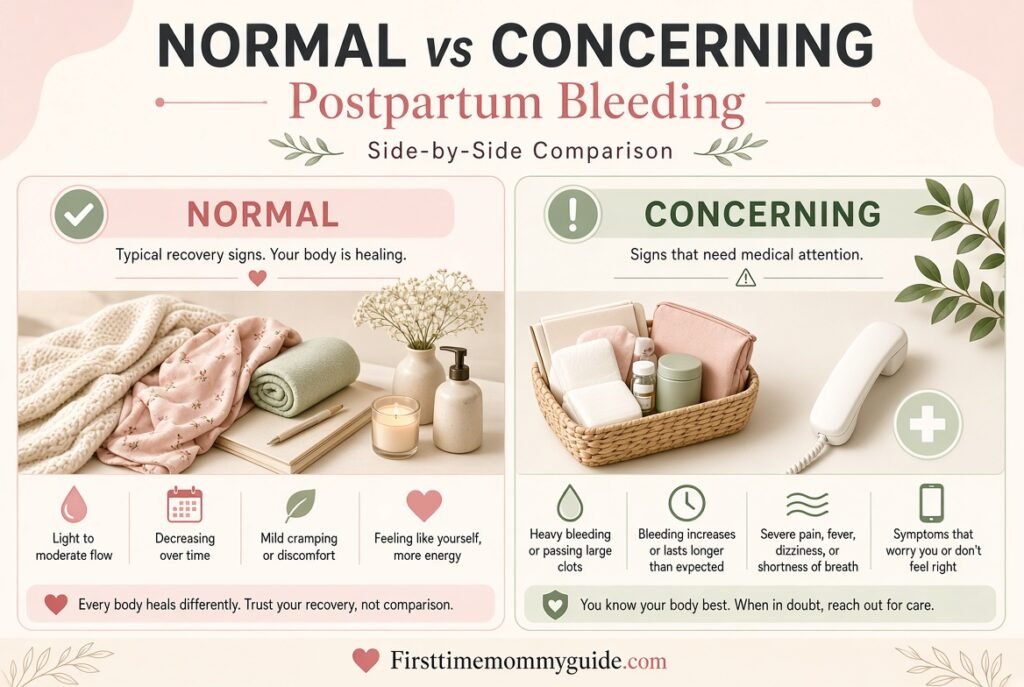
| Sign | Likely Normal | Call Your Provider |
|---|---|---|
| Amount | Less than one pad in a few hours | Soaking a pad in an hour or less |
| Duration of the return | A few days, then tapers | Heavy and continuing or worsening |
| Clots | Small, occasional, grape-sized or less | Golf ball sized or larger, repeated |
| Smell | Musty, like a period | Foul, strong, or unpleasant |
| Fever | None | 100.4°F (38°C) or higher |
| Pain | Mild cramping | Severe or worsening pelvic pain |
| How you feel | Tired but stable | Dizzy, faint, weak, heart racing |
| Pattern | Gradual fade with brief returns | Stopped completely, then heavy bright red |
Lochia vs Your First Period: How to Tell Them Apart
The clearest clue is a clean break. Lochia tapers and fades, while a period arrives after bleeding has genuinely stopped for days or weeks.
| Feature | Lochia | First Postpartum Period |
|---|---|---|
| Timing | Continuous from birth, fading over weeks | Returns after a clear gap in bleeding |
| Duration | Up to 6 weeks or more | Usually 3 to 7 days |
| Trend | Gets lighter over time | Follows a typical period pattern |
| Texture | Thicker, may contain tissue | More like a normal period |
| Odor | Musty but not foul | Normal period smell |
What Your Provider Will Likely Do
Knowing what to expect makes the call easier to make. Most evaluations are quick and straightforward.
- Ask about your bleeding pattern — how many pads, over how long, and what changed
- Check your temperature and vitals — to look for infection or blood loss
- Feel your uterus — to check whether it is firm and shrinking properly
- Order an ultrasound — to look for retained placental tissue
- Run bloodwork — to check hemoglobin and rule out anemia or clotting problems
- Prescribe treatment — antibiotics for infection, uterotonics, or a procedure if tissue remains
How to Reduce Bleeding Flare-Ups at Home
None of these replace medical care, but they help if your provider has already told you things look normal.
- Rest more than feels necessary, especially in the first two weeks
- Avoid lifting anything heavier than your baby
- Use pads only, never tampons or menstrual cups, until cleared
- Empty your bladder often, since a full bladder stops the uterus contracting well
- Keep up with stool softeners and fiber to avoid straining
- Stay hydrated and eat iron-rich foods to support recovery
- Track your pad count so you can give your provider real numbers
Mistakes to Avoid
- Waiting to see if heavy bleeding settles on its own before calling
- Assuming a C-section means you will not bleed much
- Using tampons, which raise infection risk in a healing uterus
- Returning to workouts before your 6-week clearance
- Dismissing a fever as “just being run down”
- Assuming your period cannot return while breastfeeding, which is not guaranteed
When You Should Feel Reassured

A brief return of bright red bleeding after an active day, with no fever, no foul smell, and no dizziness, is usually your body’s normal healing pattern. It should taper within a few days.
Still, trust your instincts. If something feels wrong to you, that alone is a good enough reason to call.
Also Read:
- Bleeding After Birth Stopped Then Started Again: Causes and Warning Signs
- How to Stop Postpartum Bleeding Faster? Safe Tips
- How Long Do You Bleed After You Give Birth? Full Timeline Guide
- How Long Does Bleeding Last After Birth If Breastfeeding?
- After Giving Birth First Period: Timeline, Symptoms & What’s Normal
- Pelvic Pain During Pregnancy: Causes, Relief & When to Worry
- SPD Pregnancy: Symptoms, Causes & Relief Tips
- Best Electrolytes for Pregnancy: Safe Picks & Expert Tips
- Sunny Side Up Baby: What It Means and How to Turn Baby
- Sex Positions to Induce Labor: Safe Options
- Pregnancy Guide Month by Month: Symptoms & Baby Growth
- 33 Weeks Pregnant: Symptoms & What to Expect
- 25 Weeks Pregnant: Symptoms, Baby Size & What to Expect
- 17 Weeks Pregnant: Symptoms, Baby Size & What to Expect
- Pregnancy Week By Week 7: Symptoms & Baby Size
- FBS Test for Pregnant: Normal Range, Purpose & Next Steps
- Maternity Leggings: The Complete Guide for Every Trimester
- Leggings in Pregnancy: Is It Safe Every Trimester?
- Hospital Bag Checklist for Baby: The Complete Packing List
- Newborn Coming Home Outfit: What to Pick and What to Skip
- Baby Essentials Checklist 0 to 3 Months
- Baby Sleep Guide for New Moms: Safe Sleep & Schedules
- When Do Infants Roll From Tummy to Back?
- When Do Babies Start Sitting Up? Milestone Guide
- How to Become a Midwife: Step-by-Step Guide
Frequently Asked Questions (FAQs)
Is it normal for postpartum bleeding to stop then start again bright red?
A brief return is often normal within the first 6 weeks, usually from activity or the placental scab detaching. A complete stop followed by heavy bright red bleeding should be checked.
How long does postpartum bleeding normally last?
Most bleeding finishes by 4 to 6 weeks. Some people bleed lightly for up to 8 weeks or longer, and that range can still be normal.
What does bright red blood mean weeks after birth?
Fresh bright red blood means active bleeding rather than old blood. Early on it is usually normal healing, but after the first week it is worth reporting.
Can walking or exercise restart postpartum bleeding?
Yes. Increased activity raises blood flow to the healing uterus and commonly triggers a temporary return of bleeding.
Can breastfeeding cause bleeding to start again?
Yes. Nursing releases oxytocin, which contracts the uterus and can push out pooled blood, often during or right after a feed.
How do I know if it’s my period or lochia?
A clear break of several days or weeks before bright red bleeding returns points to a period. Lochia fades gradually instead of restarting cleanly.
What is secondary postpartum hemorrhage?
It is significant bleeding occurring more than 24 hours after delivery and up to 12 weeks postpartum. It needs medical evaluation.
What causes secondary postpartum hemorrhage?
The most common causes are uterine infection and retained placental tissue. Subinvolution of the placental site and clotting disorders can also cause it.
How much bleeding is too much after birth?
Soaking a full-size pad in one hour or less is too much. That level of bleeding needs urgent medical attention.
Are clots normal in postpartum bleeding?
Small clots are common in the first few days. Clots larger than a golf ball, or repeated large clots, need to be reported right away.
Can retained placenta cause bleeding weeks later?
Yes. Even a small retained fragment can stop the uterus contracting fully, leading to bleeding that restarts or never properly resolves.
What are the signs of a uterine infection after birth?
Foul-smelling discharge, fever above 100.4°F, chills, pelvic pain, rapid heartbeat, and feeling generally unwell are the main warning signs.
Do I bleed less after a C-section?
Bleeding is often somewhat lighter, but it still happens. The placenta still separated from the uterus, leaving open blood vessels to heal.
Can constipation cause postpartum bleeding to return?
Straining raises abdominal pressure and can dislodge healing tissue. Stool softeners and fiber help prevent this.
Can having sex too early cause bright red bleeding?
Yes. Intercourse before the cervix and vaginal tissue heal can cause fresh bleeding and raises infection risk.
Should I use tampons for postpartum bleeding?
No. Use pads or disposable underwear only until your provider clears you, usually around 6 weeks.
When will my period return after giving birth?
Formula-feeding moms often see a period around 6 to 12 weeks. Exclusive breastfeeding usually delays it, sometimes for many months.
Can I get pregnant before my period returns?
Yes. Ovulation happens before your first period, so contraception matters even if you have not bled yet.
What is subinvolution of the uterus?
It means the uterus is not shrinking back to normal size properly, which keeps placental site blood vessels open and bleeding heavier.
Does bright red bleeding mean I did something wrong?
Usually not. It is most often normal healing or simply a sign to slow down and rest more.
What tests will my doctor run?
Expect a physical exam, vital signs, often an ultrasound to check for retained tissue, and bloodwork for anemia or infection.
Should I go to the ER or call my provider first?
Call your provider for most concerns. Go straight to the ER if you are soaking a pad hourly, passing large clots, or feeling faint.
Can dehydration or anemia make bleeding worse?
They do not cause bleeding, but they make you feel far worse during it. Hydration and iron-rich foods support recovery.
Is it normal to still be bleeding at 8 weeks postpartum?
For a minority of women, yes. But bleeding that is still bright red or heavy at 8 weeks should always be evaluated.
When should I stop worrying about postpartum bleeding?
Once bleeding has fully stopped, your uterus has returned to normal size, and your provider has cleared you at your postpartum checkup.
Conclusion
If your postpartum bleeding stopped then started again bright red, the most common explanations are harmless: a detaching placental scab, too much activity, breastfeeding contractions, or your first period returning. Most of these settle within a few days of rest.
But this is one area where it is always better to call. Fever, foul odor, large clots, soaking a pad in an hour, or feeling faint are not symptoms to sit on. Your provider would far rather reassure you over the phone than treat a complication that waited.
Sources worth citing in the published version: ACOG Practice Bulletin on Postpartum Hemorrhage, Cleveland Clinic’s lochia guidance, NHS postpartum bleeding pages, and the WHO Task Force data on lochia duration.

Dilawar Mughal
Founder and editor, First Time Mommy Guide
I research every guide against what the NHS, the AAP and the WHO publish, then write it in plain English — because most new parents are reading with one hand free, not comparing clinical guidelines. I'm not a doctor or a midwife. Every health claim on this site is sourced and linked so you can check it yourself, and anything urgent belongs with your health visitor or GP, not a blog.